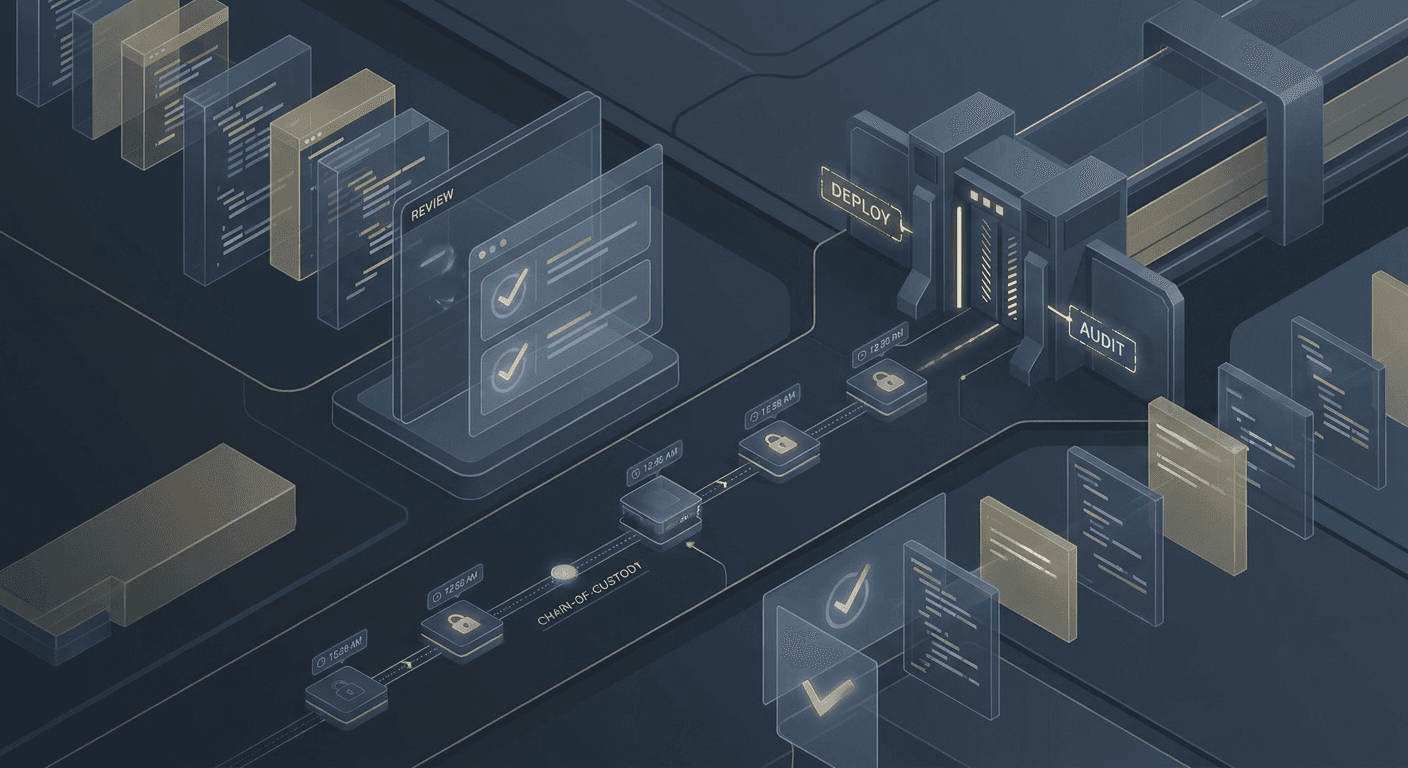
When AI Writes Most of the Code, Auditability Becomes the Product
When AI Writes Most of the Code, Auditability Becomes the Product
The interesting part of Anthropic saying Claude authored more than 80% of the code merged into its production codebase in May is not the percentage itself.
The percentage is the bait.
The real story is what happens to software engineering when code generation stops being the bottleneck and control becomes the limiting factor again.
A lot of people will read that claim as another milestone in the “AI can code now” narrative. That misses the more useful implication for enterprise teams. If a model can generate most of the code that gets merged, then the center of gravity shifts. The hard problem is no longer mainly producing code quickly. It is making sure the resulting system remains reviewable, attributable, testable, reversible, and governable under production conditions.
That is a much less glamorous story than autonomous coding, but it is the one that actually matters.
What actually happened
Anthropic disclosed that more than 80% of the code merged into its production codebase in May 2026 was authored by Claude. Predictably, that number immediately invites two bad reactions.
One group treats it as proof that software engineering is about to disappear into prompt-driven automation. The other treats it as marketing theater and dismisses it because “merged code” says nothing on its own about complexity, review depth, or engineering quality.
Both reactions are too shallow to be useful.
The more important signal is that at least one frontier AI company is now operating in a workflow where model-generated code is not exceptional. It is normal enough to become part of the production baseline. That changes what engineering management, platform teams, and governance functions need to care about.
Why generation is no longer the hard part
When a system can generate code cheaply and continuously, the bottleneck moves downstream.
This is not new in software. Whenever one constraint disappears, another becomes the real delivery limit. In this case, what gets harder is not writing candidate code. It is managing the consequences of an enormous increase in candidate change volume.
If code can be produced faster than humans can meaningfully reason about it, then the system starts to depend on controls around the code rather than effort spent writing it.
That changes the value of several engineering disciplines:
- review quality matters more than raw generation speed
- test design matters more than local code elegance
- provenance matters more than authorship prestige
- rollback design matters more than merge throughput
- observability matters more than confidence in the prompt
- architectural boundaries matter more than whether one model is slightly better at syntax than another
This is where a lot of current AI coding discussion still sounds immature. Too much of it is focused on whether a model can implement a feature, refactor a file, or pass a benchmark. Those are interesting capabilities, but they are not the main production question.
The production question is whether the organization can absorb AI-generated change safely.
What changes in enterprise engineering
Once AI becomes a large share of code output, software governance starts to look different.
1. Review stops being optional craftsmanship and becomes a scaling system
A human reviewer can no longer behave as if they are carefully reading every line in the same way they would in a low-volume manual workflow. That does not scale. Review has to become risk-tiered.
Low-risk changes need fast paths, strong automated checks, and clear blast-radius limits. High-risk changes need deeper human review, stricter approvals, and stronger traceability. If every AI-generated change gets the same review treatment, the process collapses under volume. If AI-generated changes get too little scrutiny, the system degrades quietly until a failure makes the weakness obvious.
The goal is not “review everything manually.” The goal is to build a review system that knows where human judgment is irreplaceable.
2. Provenance becomes operationally important
When a bug, security issue, or bad design decision appears later, teams need to know more than which engineer clicked merge.
They need to know:
- which model generated the change
- which context or prompt led to it
- which tools or repositories were involved
- which tests passed
- which reviewer approved it
- which deployment carried it into production
That is no longer documentation nice-to-have. It becomes a core part of incident reconstruction and accountability.
Traditional source control gives some of this, but not enough if agentic coding workflows become normal. Enterprises will need better provenance capture around AI-assisted development than most teams have today.
3. Test architecture becomes the real quality gate
If code generation becomes abundant, test design becomes one of the highest-leverage engineering activities in the system.
A weak testing strategy under human-only development is already dangerous. Under high-volume AI-assisted development, it becomes catastrophic. You are effectively increasing change throughput without increasing confidence unless your validation layer is strong enough to keep up.
This is one reason benchmark headlines about coding ability are less important than they look. A model can be very good at producing plausible code and still be operationally dangerous inside a weak engineering system.
The useful question is not “can the model code?” It is “what catches the model when it is wrong in subtle ways?”
4. Rollback design becomes more important than people admit
Many teams still treat rollback as a deployment feature. In AI-assisted software delivery, rollback becomes a design requirement.
If a system is producing more changes, more often, and with more machine-generated variation, then rollback cannot just mean “revert the last commit.” Real failures may depend on generated code, prompt changes, evaluation drift, tool behavior, and interactions across multiple services.
You need to be able to answer:
- what exactly changed
- what else depended on that change
- how safely you can revert it
- whether the AI workflow that generated it is still active
- whether the same failure mode will simply regenerate
This is where a lot of AI-enhanced development will hit reality. Teams will discover that generating code was easy. Undoing machine-accelerated mistakes cleanly is much harder.
5. Ownership gets blurry unless you make it explicit
Enterprise systems already suffer when ownership is vague. AI-generated code makes this worse.
If a model authored the implementation, a reviewer approved it, a platform team provided the coding agent, and another team owns production support, who is accountable when the change causes damage?
The answer cannot be “the AI wrote it.” That is not a governance model. Someone still owns the system, the risk, and the consequences.
Organizations adopting AI-assisted development at scale need explicit ownership boundaries around:
- who approves which classes of AI-generated changes
- who owns the coding workflow itself
- who is responsible for model/tool configuration
- who handles incidents tied to generated code
- which controls are required before merge and before release
If those boundaries remain fuzzy, the speed gain will eventually be paid back as operational confusion.
Where the hype breaks
The bad version of this conversation treats AI code generation as if more output automatically means more progress.
It does not.
A company can merge a huge amount of AI-generated code and still build a fragile, opaque, or expensive engineering system. Volume alone says almost nothing about maintainability or long-term software quality.
There is also a temptation to imagine a near future where engineering becomes mostly supervisory. That may happen in some narrow workflows, but most enterprises are nowhere near ready for that operating model. Their repositories, test practices, access control, release discipline, and architecture boundaries are not mature enough.
In weaker organizations, AI coding will often amplify the existing flaws:
- messy repos become messier faster
- bad tests create false confidence faster
- poor review habits become dangerous faster
- weak ownership becomes more ambiguous faster
The tools are powerful. That does not mean the surrounding system is ready to absorb them.
What technical leaders should do now
If you are responsible for enterprise software delivery, this is the useful takeaway: stop treating AI coding mainly as a productivity feature and start treating it as a governance and systems-design issue.
In practice, that means:
- define which classes of changes can be AI-assisted with minimal oversight and which cannot
- capture provenance around model-generated changes, not just commit history
- strengthen validation layers before scaling generation volume
- build rollback paths for high-frequency AI-assisted delivery
- separate coding-agent experimentation from production merge policy
- establish clear ownership for coding workflows, approvals, and incidents
- evaluate AI coding tools less on demo speed and more on traceability, control, and operational fit
The companies that handle this well will not necessarily be the ones with the flashiest agent demos. They will be the ones that turn AI-generated change into something legible and governable.
Bottom line
If AI writes most of the code, the strategic problem changes.
Generation stops being the scarce resource. Control does.
That is why Anthropic’s disclosure matters. Not because it proves software engineering is over, and not because one number settles the quality debate. It matters because it shows where the next operational bottleneck is going to be.
As AI-generated code becomes normal, the differentiator will not be who can produce the most code fastest. It will be who can keep that code auditable, testable, reversible, and safe enough to trust in production.